What are UK pig farms like?
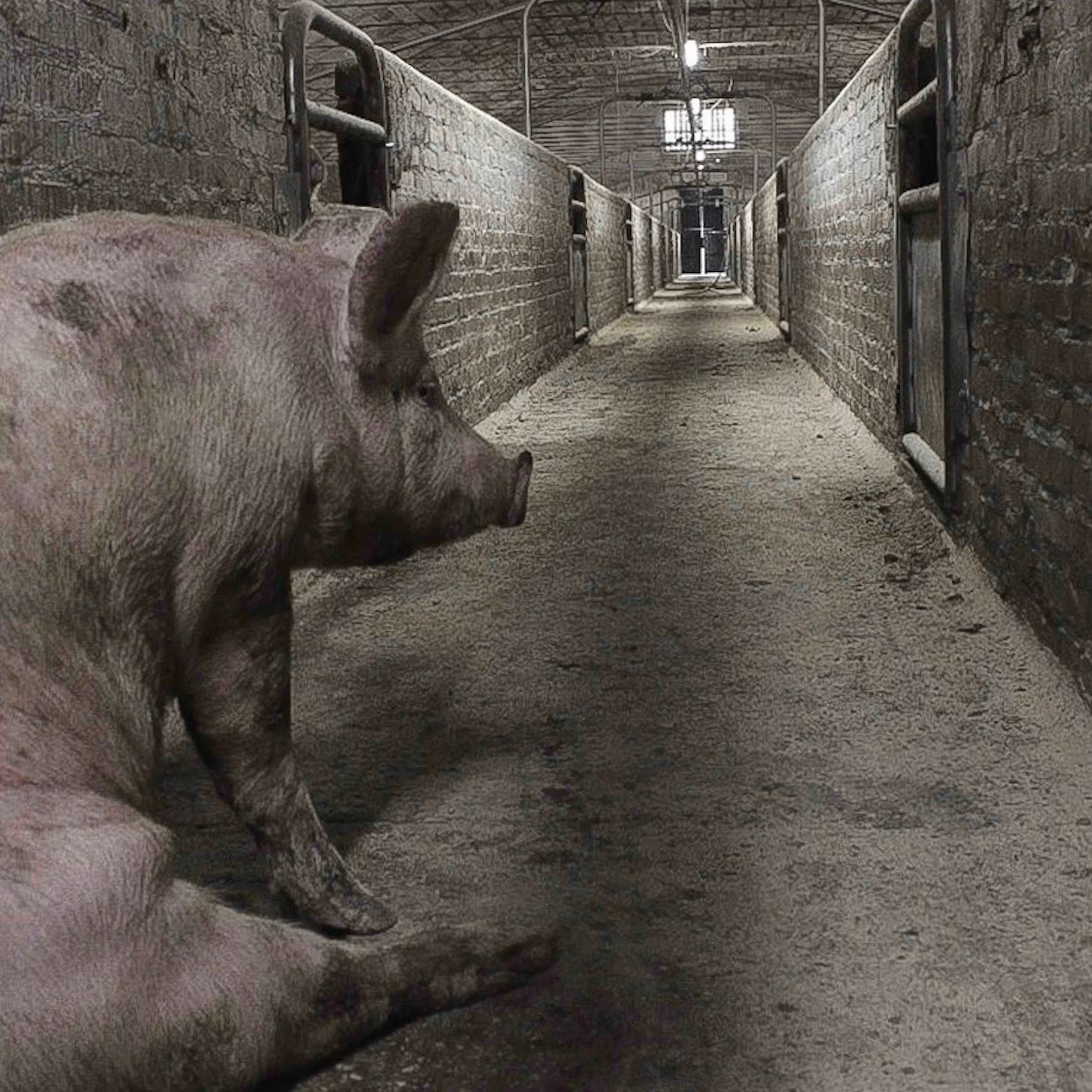
Most pig farms in the UK are considered to be intensive ‘factory farms’ which may house many thousands of pigs at a time in long sheds. Farm operations are divided into two main parts; breeding and fattening, with most farms carrying out both parts of the farming process.
Breeding pigs are selected for having a large number of babies who in turn have a high ‘food conversion’ - for comparatively low amounts of food given, they grow and put on weight quickly. Fattening pigs are those which are born and raised to be killed for meat.
Pig farms produce very high volumes of foul-smelling urine and faeces, which is often collected in large open-air slurry-pools.
How are pigs farmed in the UK?
Over 10 million pigs are raised and killed for their meat every year in the UK. 93% of them are reared indoors, and around 60% of them are kept in pens without any bedding.
Piglets are weaned from their mothers at 3-4 weeks old and moved into large sheds divided up into pens where the piglets are kept in densely crowded groups. About half of pigs are kept on fully or partially slatted floors without meaningful enrichment.
Because the pigs are so under-stimulated, tail-briting is a serious problem in the industry, resulting in 80% of pigs in the UK having their tails cut off shortly after birth and many also having their teeth cut to be more blunt. These mutilations are carried out without any pain-relief.
Piglets are ‘fattened’ for 5 months until they weigh around 100kg, at which point they are loaded onto trucks and transported to slaughterhouses to be killed either through gassing with CO2 or electrical stunning and throat-cutting.
What is the welfare of pigs raised for meat?
Welfare problems for pigs in intensive farms start from the day they are born, regardless of the system in which they are born. Sows have been selectively bred to have too many young, meaning that some are small and weak, or have to be removed from their mothers and switched to another litter in order to survive. Within days the piglets endure multiple mutilations without pain-relief including tooth cutting, tail-docking and ear-notching.
For the majority of piglets, who are born into intensive systems, life begins on slatted floors without any bedding for them to hide or sleep comfortably. They are separated from their mothers too early. Naturally, piglets would wean at around 13 - 17 weeks of age, but farmers remove piglets from their mothers at just 3-4 weeks old.
The piglets are then moved into mixed social groups, in pens that quickly become over-crowded as they grow. Despite the fact that the law requires pigs to be given enrichment, in practice most enrichment provided is relatively meaningless and does not satisfy the needs of the young pigs resulting in chronic boredom and stress.
“
It’s hard for young pigs to even rest in such crowded, barren pens. Just when they settle down for a nap another pig, worked-up with unspent energy and curiosity, comes over and climbs on them or starts rooting around underneath them or nibbling at their ears. You can just see that these animals are so incredibly frustrated because they have nothing to do.
~ Rich Hardy, Investigator
The crowding in pig farms has another effect - that of the impact of cleanliness on welfare. Pigs are very clean animals, and when given the opportunity will toilet far away from where they eat and sleep. They famously wallow in mud - which bakes hard in the sun and crumbles off - in order to keep themselves clean, but on factory farms the pigs are forced to defecate all over their pens, and as a result often spend their lives covered in excrement.
What is life like for a ‘breeding sow’?
In both intensive and outdoor systems in Europe, sows are kept in groups in between litters, and are then housed individually during the latter part of pregnancy and while they have their babies with them.
A female breeding pig is known as a ‘gilt’ until she has her first litter, and is then called a sow. She will be 6 months old when she is first impregnated, either through artificial insemination or by being placed in a group pen with a male pig. A month later, ultrasound is used to confirm pregnancy, and the mother-to-be is moved into group housing with other gilts and sows.
Pregnancy lasts for 3 months, 3 weeks and 3 days, at which point she will give birth to between 10 and 14 babies. She will nurse them for around 3-4 weeks until the babies are taken away. Around 5 days after weaning, sows are then re-impregnated, and the cycle begins again.
Each sow will have about 3 - 5 litters before her fertility starts to reduce and she is culled, at around 1 ½ to 2 years old, because she is no longer as economically viable as a younger sow.


 Pru Elliott