The Humane League
  • Donate

Sign UpDonate
Our Campaigns
Latest news
Learn more
Work With Us
  • For Media
  • Events
  • Shop
Follow US
  • Facebook
  • Twitter/X
  • Instagram
  • Youtube
  • Cookie Preferences
  • Cookie Policy
  • Privacy Policy
  • Privacy policy for job applicants
  • Terms and Conditions
  • Our Partners

Contact Us

  • The Humane League UK
    The Offices
    57 Newtown Road
    Brighton
    BN3 7BA

  • info@thehumaneleague.org.uk

  • 0800 014 8081

About Us

  • About Us
  • Discover
  • For Media
  • For Business
  • Our Trustees
  • Contact us
  • Our AI Commitment

Take action

  • Our Campaigns
  • Volunteer with Us
  • Work with Us
  • Gifts in Wills

Donate

  • Donate
  • Our Supporter Charter
  • Code Of Conduct
  • Fundraising Complaints Procedure
  • Fundraising FAQs

Shop

  • All Products
  • Returns & Exchanges
THL-mended-heart-icon-padding-01

Be a part of the change. Take action #ForTheAnimals.

Take action
2025 Recommended charity
Registered with the Fundraising Regulator
  • Facebook icon white
  • Twitter icon white
  • ic-instagram-white-normal 2x.png?h=250
  • Youtube icon white
  • Cookie Policy
  • Privacy Policy
  • Privacy policy for job applicants
  • Terms and Conditions
  • Our Partners

Registered charity no. 1177926 | The Humane League. All rights reserved.

Unless otherwise noted all imagery of factory farms on this site is representative of typical conditions.
Factory farming

What Is Foie Gras and Why Is It Cruel?

What is foie gras, how is it made, and why is it so cruel? Find out what you can do to help.

Jamie Gittins
Jamie Gittins
Jun 04, 2024
Share
twitter-white-icontwitter-white-icon
fb-white-iconfb-white-icon
linkedin-white-iconlinkedin-white-icon
email-white-iconemail-white-icon

What is foie gras, how is it made, and why is it so cruel? Find out what you can do to help.

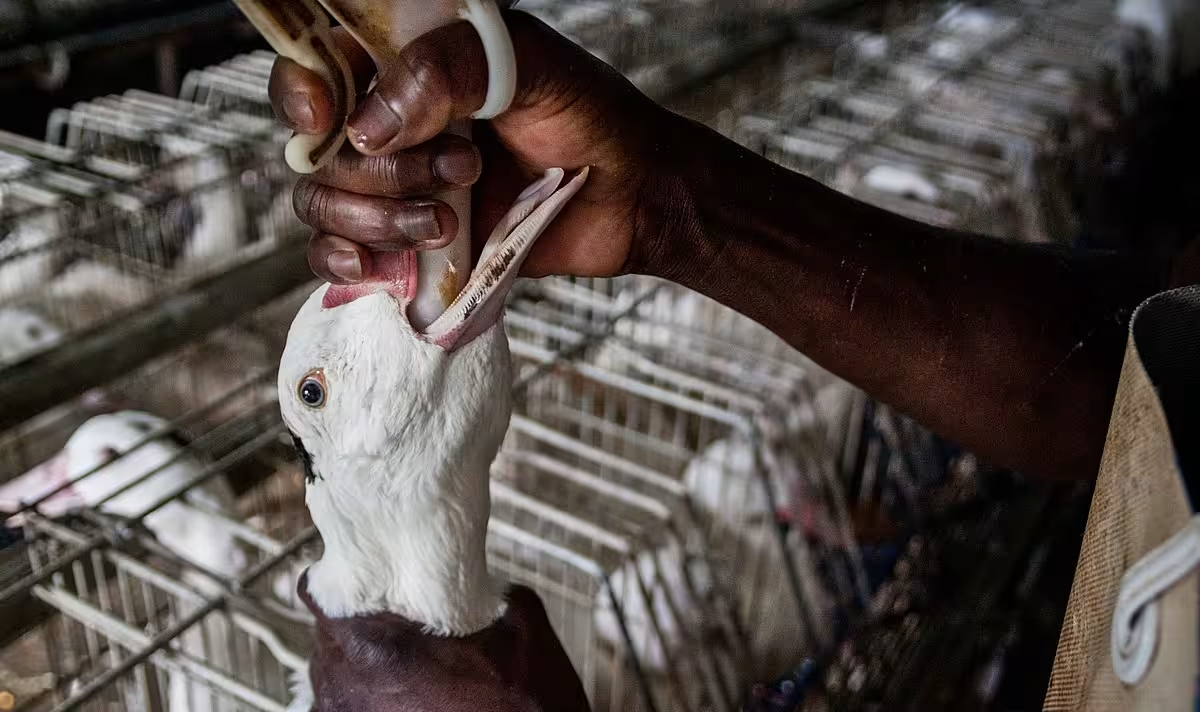
Goose neck clasped in farmers hand while feed tube forced down throat.
Luis Tato/HIDDEN/We Animals Media
Share
twitter-black-icontwitter-black-icon
fb-black-iconfb-black-icon
linkedin-black-iconlinkedin-black-icon
email-black-iconemail-black-icon
twitter-icontwitter-icon
fb-iconfb-icon
linkedin-iconlinkedin-icon
email-iconemail-icon

You may have heard of foie gras as a ‘luxury’ food that is famous in French cuisine. However, in order to produce it, extreme cruelty is inflicted upon ducks and geese.

More Like This

Pigs on a factory farm
Our Movement

Is animal welfare the same as animal rights?

The difference between animal rights and animal welfare, explained

THL
THL
Nov 16, 2023
factory-fish-farming-the-humane-league
Factory farming

What is fish farming, is it cruel and what can you do? We answer these questions for you.

What is fish farming, how does it work, and is it cruel?

Maddy Dawe
Maddy Dawe
Jul 12, 2022

What is foie gras?

Foie gras is made from the enlarged, fatty liver of a duck or goose. This is often made into a pâté or mousse. By the time that the bird is slaughtered for foie gras, their liver can be up to 10 times its normal volume. The liver grows so large because the birds are force-fed several times a day, causing a disease called hepatic steatosis.

Why is foie gras so cruel?

The production of foie gras is an incredibly cruel process, as it involves a roughly two week period during which birds are force-fed through a tube.

Two or three times a day, a feeding tube is forced into the bird’s throat and large quantities of food are then pumped into their stomach. By the end of the force-feeding period, the birds are being force-fed so much that it would be similar to a human consuming a whopping 20kg of food per day.

During this time, most birds are confined to small cages, with only a small opening at the front to make it easy for their necks to be held during force-feeding. The process also involves birds being handled to stop them from struggling, which can be very stressful. In addition, the feeding pipe can damage the birds’ throats.

During foie gras production, many of the other welfare needs of ducks and geese are also denied. The cages used to confine the birds prevent them from performing many of their natural behaviours such as stretching their wings and walking around. The stressful handling, excessive feeding, and poor housing also contribute to high levels of disease and mortality on farms.

Ultimately, after around just 100 days of life, the birds are slaughtered and their painfully enlarged livers are removed in order to make foie gras.

What is the law on foie gras?

Due to its cruelty, production of foie gras is illegal in several countries around the world, including the UK, Germany, Turkey and Israel. However, it is still legal to import and sell foie gras in the UK.

There were plans for the UK Government to ban the import and sale of foie gras. However, the plans were shelved in early 2022 after certain ministers opposed it and was officially dropped under Liz Truss. This backtracking on a ban means that animals continue to needlessly suffer simply to supply the UK with these cruel products.

The new Labour Government ran its election campaign with a promise to ban foie gras, but has so far remained silent on the issue and taken no steps to do so.

What can I do to help?

  • Sign this petition by Chris Packham, which calls on the Government not to abandon its plans to ban fur and foie gras.
  • If you see foie gras for sale you could speak to the business owner or manager, explain why foie gras is cruel, and ask them if they would remove it from sale.
What is foie gras, how is it made, and why is it so cruel? Find out what you can do to help. | The Humane League UK