


How cows make milk, and why humans are exploiting them
We lay out the facts behind milk production.
 THL
THL


We lay out the facts behind milk production.
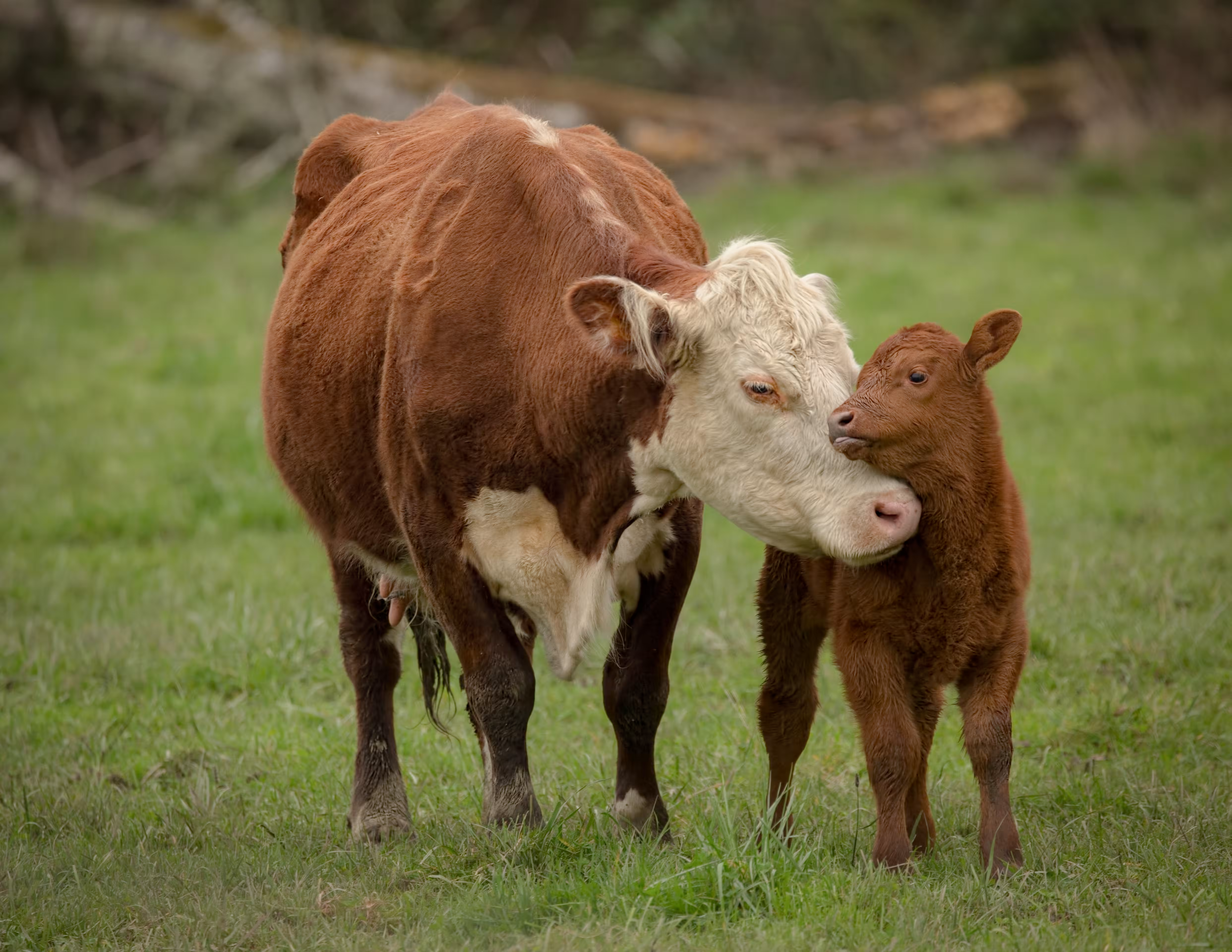


The marketing departments at milk companies work hard to make consumers believe that dairy cows spend their days living naturally, munching on grass and cuddling with the farmers who milk them.
However, nowhere is ‘humane-washing’ more evident than in the marketing of dairy products. That’s because the stark reality for dairy cows is that their day-to-day life is actually filled with tremendous suffering. In fact, some experts caution that dairy cattle suffer even more than beef cattle.
Understanding how cows make milk, and why, is key to learning how they are exploited.
Do dairy cows have to give birth to make milk?
Before female cows produce milk, they have to be impregnated and give birth. They produce milk for about ten months after giving birth. Each year, from around two years of age, they are then continually impregnated and give birth to ensure maximum milk production.
This continues until they stop producing as much milk - they rarely live past the age of six, even though their natural lifespace is up to 25 years. At that point they’re removed from the herd and slaughtered, often for ground beef.
Can only female cows produce milk?
Only female cows are able to produce milk, as only females can get pregnant and give birth - a necessary prerequisite.
Do farmers force cows to get pregnant?
Forced impregnation via artificial insemination is common practice on dairy farms. The procedure involves farmers sticking their hands into the cow’s anus and inserting a long, thin rod into her vagina to deposit previously collected semen.
How do cows make milk?
Just like humans and other mammals, cows must be pregnant and give birth in order to produce milk. To then enrich that milk with nutrients and energy, cows consume grass, which is processed through their four chambered stomach, each one playing a specific role.
The first chamber - called the rumen - is the largest. It is responsible for storing and fermenting feed and grass. This results in a lot of burps, which is a major source of methane emissions.
The reticulum is the smaller, second chamber. It holds any foreign or indigestible objects that the cow may consume. The next chamber, the omasum, absorbs nutrients and water from the feed. The last chamber, the abomasum, contains acid that further breaks down the feed before it finally passes out of the stomach.
Are all dairy cows female?
While all cows are female, including dairy cows, many of the calves they birth are male. Because male calves can’t produce milk, they’re often killed soon after birth or are sold to be butchered for veal.
What problems can forced milk production cause?
Repeated forced impregnation and high milk production leads to severe health problems in dairy cows. Oftentimes these ill or injured cows are culled (killed), rather than treated.
Infertility
Counterproductively, cows with the highest milk production are also those at greatest risk of experiencing infertility. In fact, as milk production has trended upward over the last several decades, so too has infertility among dairy cows.
Lameness
Dairy cows who suffer even minor lameness stop producing as much milk. Lameness is often the result of lesions on their hooves or infections such as foot rot - an infection that can result from environmental factors, such as the unsanitary conditions on factory farms.
Mastitis
It’s no secret that dairy barns are filthy. Video evidence from farms often reveals cattle standing in a slurry of waste. These conditions contribute to the high occurrence of infections, including mastitis, a painful inflammation of the mammary region.

Do cows feel pain when milked?
As a natural process, cows should not feel pain when they’re milked. However, with so much importance now put on increasing productivity (as is the case with any industrial farming) what should be a pain-free bonding experience between calf and mother cow often becomes excruciating. This is due in great part to the sheer amount of milk a single dairy cow is made to produce.
Experts argue that if a herd’s average cow isn’t producing a minimum of 75 pounds of milk daily, the herd isn’t ‘producing well’. The issue is that over the last several decades, the amount of milk cows are making has skyrocketed, and along with that so have welfare issues. For example, the average cow in the United States - the country that bottles the most milk - produced 21,000 pounds of milk in 2010. By 2023, that grew to over 24,000 pounds.
As milk yields increased, so too have health and welfare issues affecting dairy cattle, including mastitis, weight loss, and blood disorders. These issues can make the process of producing milk, and being milked, very painful.
What happens to the calves?
What happens to a dairy calf depends on their sex. Female calves are likely to be raised to replace their mothers, while male calves are often slaughtered for veal - meat from a baby calf.
Weaning rings
Weaning rings prevent calves from suckling from their mothers. The rings are fastened to the calf's nose and sport spikes. When the calf goes to suckle, the spikes cause the mother cow to kick at or move away from her baby.
Disbudding
Calves in the UK are commonly disbudded, meaning they have their horns removed via a corrosive paste or hot iron. This is done to reduce the likelihood of the animals injuring staff or each other in the close, cramped quarters they are forced to live in.
Because they’re slaughtered so young, male calves raised for veal are usually not disbudded.
Tail docking
Tail docking is a common practice in some countries; it is wrongfully believed to increase cleanliness. In the UK, the procedure - which involves removing up to two thirds of the tail - is considered a mutilation, and is thus illegal.
Do cows produce more milk than calves need?
Cows on factory farms today have been bred to produce significantly more milk that their calves could consume. If calves stayed with their mothers, they’d drink about 20% of their body weight in milk daily. A typical holstein calf weighs about 100 pounds, meaning they’d likely consume about 20 pounds of milk a day. In contrast, their mothers produce a whopping 75 pounds daily.
Dairy calves taken from their mothers right after birth (and allowed to live) are instead bottle-fed about 10% of their weight, so that they start eating solid food sooner. Giving them so little milk leads to distress and poor health and welfare outcomes, such as less weight gain and less time spent playing.
The bottom line
Don’t believe the milk ads - dairy farms are responsible for vast animal suffering. Dairy cows are repeatedly impregnated, yet never have the chance to raise their babies, despite forming a tight bond when given the opportunity. Instead, her milk is bottled and sold to humans - the only adult animal to drink the milk of another species.
If you agree that animal suffering is wrong, why not leave dairy off your plate?
And if you’d like to join us as we fight for a world where animals raised for food are not abused, sign up now.