


What laws protect farmed animals in the UK?
Current gaps in legislation leave animal welfare at risk on British farms.
 THL
THL


Current gaps in legislation leave animal welfare at risk on British farms.


Although UK law aims to protect animals, you might be surprised to know that in many cases it does not do enough to protect their welfare: leaving many animals exposed to pain, distress, and unnecessary suffering.
Animal Welfare Act 2006
In England and Wales the welfare of farmed animals is protected under the Animal Welfare Act (2006), a piece of law which places a duty of care on those keeping animals to ensure the animals' needs are met.
This includes the requirements:
- to provide a suitable environment
- to provide a suitable diet
- to allow animals to exhibit normal behaviours
- to be housed with, or apart from, other animals (if applicable)
- to be protected from pain, injury, suffering and disease
The Animal Welfare Act applies to all vertebrate animals (mammals, birds, reptiles, amphibians and fishes) and makes it ‘an offence to cause unnecessary suffering to any animal’. In Scotland and Northern Ireland farmed animals are covered by a similar law.
Welfare of Farmed Animals Regulations 2007
In England, farmed animals are also protected under the Welfare of Farmed Animals (England) Regulations 2007. These regulations set the minimum standards for keeping farm animals. The legislation contains requirements such as inspections alongside specific provisions for certain animals, including laying hens, calves and pigs. It also contains provisions for protecting animal welfare off-farm, such as during transportation. There are a similar set of regulations in Wales, Scotland, and Northern Ireland.
However, these protections do not prevent animals from suffering on factory farms. For example, in the UK it is still legal to keep egg-laying hens in cruel, cramped cages where they can’t perform most of their natural behaviours. Millions of hens currently suffer in these cages every year. This is why we are campaigning for the Government to ban cages for hens in the UK.
Factory farms are also using breeds of chicken for meat production who grow unnaturally fast and suffer hugely under the strain of their own overgrown bodies before being slaughtered after just 6 weeks. Over the last three years, we've been challenging this practice in a judicial review against the Government.
However, one group of animals is not even acknowledged in the Regulations…
Under the Welfare of Farmed Animals Regulations:
A 'farmed animal' is defined as an animal bred or kept for the production of food, wool or skin or other farming purposes.
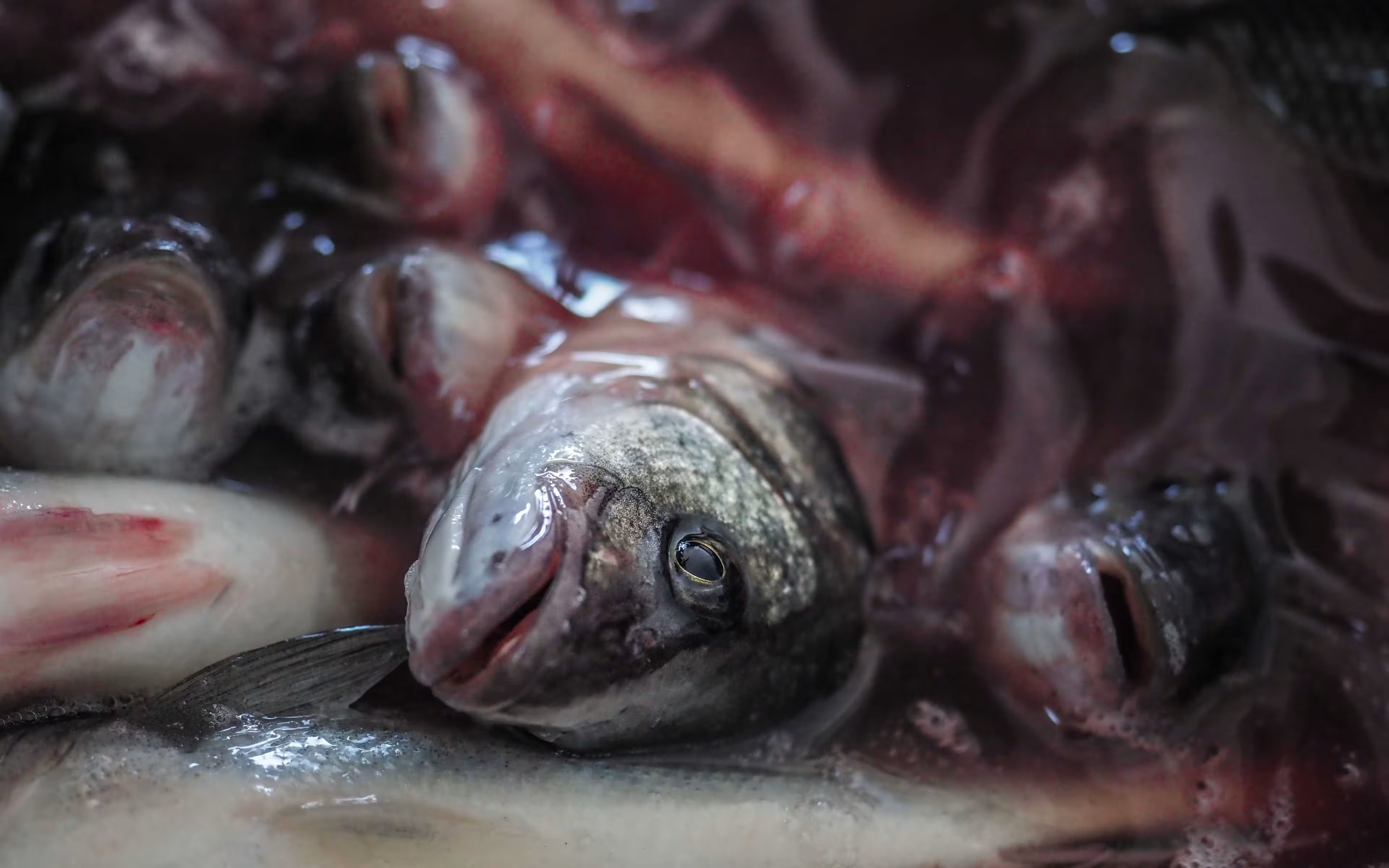
This definition only goes so far to include animals such as pigs and chickens, excluding other groups such as farmed fishes. This means that the Welfare of Farmed Animals Regulations solely applies to land farmed animals and leaves animals like fishes unprotected.
Welfare of Animals at the Time of Killing Regulations 2015
The Welfare of Animals at the Time of Killing (England) Regulations 2015, or 'WATOK', states that animals ‘should be spared any avoidable pain, distress or suffering during their killing and related operations’ and details how animals should be stunned and rendered unconscious prior to killing. There are a similar set of regulations in Wales, Scotland, and Northern Ireland.
Fishes, although included under these general protections, are not covered under the definition of an ‘animal’ in more detailed WATOK provisions. This means that there is no mention of the specific requirements as to how fishes should be held, stunned or killed.
In the UK this leaves 77 million farmed fishes without sufficient legal protections, with only the fish farming industry to regulate itself through voluntary codes. Investigations at fish farms have revealed fish being repeatedly clubbed, left to suffocate on the floor and having their gills cut while still fully conscious. Thus, voluntary codes alone cannot protect millions of fishes from suffering a painful death.

It’s currently sink or swim
Despite previous recommendations by the Animal Welfare Committee (an expert body which advises the Government) in 1996, 2014, and 2023 to include a requirement in legislation for farmed fishes to be stunned before killing, the law remains ambiguous and fails to provide detailed requirements for farmers to protect fish welfare at slaughter. With current regulation being open to interpretation, fishes are exposed to unnecessary suffering and consequently are left forgotten.
Therefore, we are calling upon the Government to address this discrepancy for fishes by updating slaughter legislation to explicitly state that farmed fishes must be stunned at the time of killing to protect them from a painful death.
Stand up for fishes
You can read more about our Forgotten Fish Campaign to learn more on the topic and see our latest campaign updates.
Want to make a difference for animals? Join thousands of others and start by signing the petition below, it'll only take a moment.


SUPPORT OUR WORK FOR ANIMALS

About The Humane League UK
We are a charity ending the abuse of animals raised for food.
Learn More