


Are animals kept in cages in the UK?
Should animals be kept in cages? The disadvantages of animal captivity, explained.
 THL
THL


Should animals be kept in cages? The disadvantages of animal captivity, explained.
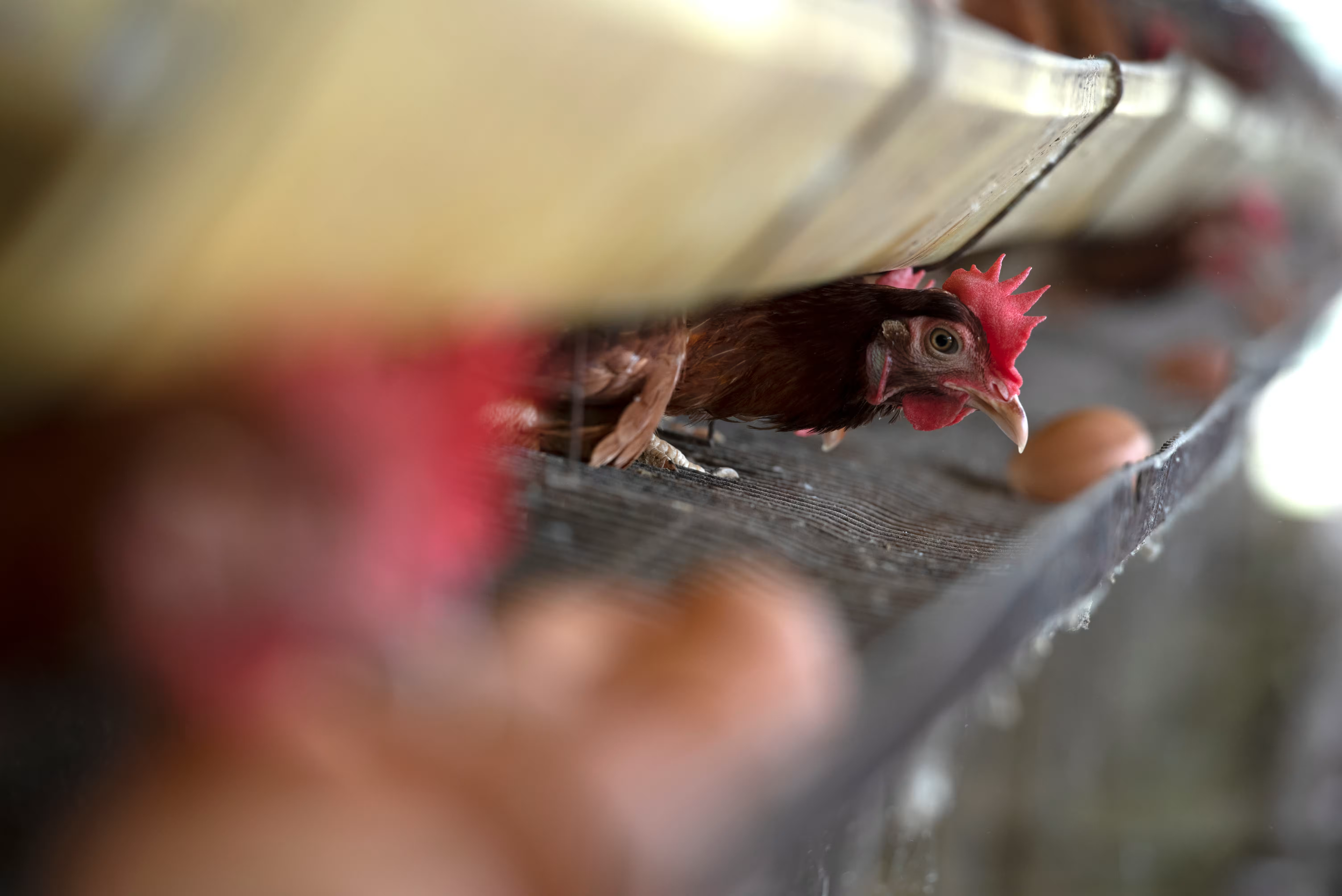


The EU has committed to phasing out cages for farm animals by 2027. Unfortunately, the UK is lagging behind. Though bans on gestation crates and battery cages for laying hens have been in place for several years, the progress has largely stopped there.
There are numerous disadvantages to keeping animals in captivity, and even more reasons animals should not be kept in cages.
What is animal captivity?
Anytime an animal is having their freedom restricted, they are being held captive. Technically, pets on leashes, horses on pasture, and elephants in a zoo are all captive.
While cages are not a prerequisite for captivity, they often make animals’ living situations worse. Nowhere is this more true than on factory farms, where animals often spend their entire lives in cages.
Why animals should not be caged
Living in a cage isn’t good for anyone, human or animal. For example, laying hens in the UK, many of whom spend their lives in so-called enriched cages, suffer from living in limited space where they can’t express normal behaviours such as wing flapping.
Do animals get depressed in cages?
It’s not just animals’ physical health that suffers in cages - they also deteriorate mentally.
If you’ve ever visited a zoo, you may have seen animals pacing or swimming in circles; likely the animal you were watching was suffering from zoochosis. Though zoochosis covers a range of mental health issues in animals, a major one is depression.
It’s not just mammals who suffer from depression either: a study published in Royal Society Open Science found that fish raised on fish farms have brain activity similar to that of depressed humans.
Are animals kept in cages in the UK?
The short answer is yes. However, some of the worst confinement systems have been banned. Barren battery cages for laying hens were banned in 2012, and gestation crates, or sow stalls, for mother pigs have been banned since 1999.
The UK’s progress on cages has not been linear. Despite the ban on battery cages for chickens raised in the UK, some members of parliament have attempted to allow the import of eggs laid by chickens in battery cages.
Are cages for animals banned in the UK?
When you think of animal cruelty, the image of a cage may come to mind. As humans, we understand the importance of personal space. The fact that so many animals are deprived of their basic rights to stretch, run around, and socialise is almost unthinkable.
An animal behind bars is something that no one likes to see.
In 2012, the European Union (EU) banned battery cages for egg-laying hens. Battery cages are small, barren wire cages where hens have less than an A4 sheet of paper to live in, and no stimulation. The EU vote that made these illegal was a great success for animal advocates.
But this did not mean the end of cages in the UK.
How many farm animals are kept in cages in the UK?
Sadly, not only is the use of 'enriched' cages still legal for hens, but cages for other animals farmed for food are still in use too. In fact, as of June 2020, over 16 million animals were estimated to still be in cages in the UK alone.
Which animals are kept in cages?
Hens
Perhaps the most commonly known animal subjected to life in a cage is the laying hen. Since the ban on battery cages in the EU, many UK producers switched to so-called ‘enriched cages’ which provide only small improvements for chickens. These cages have additional features such as slightly more space, a basic nesting area, and perches.
However, each hen is still confined to a space so small that they can never fully stretch their wings, dust bathe, or forage (all natural behaviours for these inquisitive animals). The hen will only escape this captivity when ready for slaughter - they are caged for life.
Thanks to the work of animal groups, including The Humane League UK, a huge number of companies have committed to going cage-free. But, even with all these commitments, there are still some companies sourcing eggs and ingredients from caged hens. This is why it’s so important to get cages banned once and for all.
Rabbits
It may surprise you to learn that rabbits are farmed at all. And, all the more surprising, that they’re the second-most-farmed animal in Europe.
Rabbits are largely farmed for their meat. This happens mostly in other European countries, but it exists here in the UK too. This is believed to happen on a small scale, although it’s very difficult to find accurate figures.
Sadly, these beautiful, delicate creatures are often kept in barren, wire cages. Eight or more rabbits can be crammed into a single cage, providing roughly the size of an A4 sheet of paper per rabbit. They will never get the chance to hop around freely in the grass.
Pigs
A mother pig is called a sow, and the life of a sow in the UK farming system is often one of suffering. ‘Sow stalls’ - metal crates in which a mother pig is kept for breeding - used to be common, but were banned in 1999.
However, ‘farrowing crates’ are still widely used. In these, sows are kept in cages to give birth to their piglets and for the first few weeks of their newborns’ life.
Because of the cramped conditions, they are unable to carry out the most basic behaviours - they can’t even turn their bodies around for weeks on end, or nuzzle their piglets when they want to.
Mother pigs like to build nests for their family but are unable to do this while kept in these crates. Pigs are intelligent animals and this lack of freedom makes them incredibly stressed, leading to abnormal behaviours. Sadly, 60% of sows in the UK will experience these cruel crates.
Calves
Ever heard of veal crates? These were used to confine baby calves until they were slaughtered for their meat at around only six months old. In veal crates, calves were chained up, unable to even turn around. This cruel practice was banned back in the 1990s in the UK.
However, the suffering of young cows did not end there.
It’s legal in the UK for calves to be kept in individual hutches, known as calf pens, until they are eight weeks old. They are often able to see and smell their friends, but can't play with them.
At this young age, calves would normally be running around and playing with one another, as well as spending time with their mums. It's heartbreaking to see these babies kept in pens away from their family and friends.
Pheasants, partridges and quail
Commonly referred to as ‘game birds’, pheasants and partridges are farmed for the shooting industry. These sensitive, graceful birds are bred and raised just to be released and shot by hunters. They are not afforded the limited protections given to hens, and those who are kept for breeding are often held in barren cages for their whole lives.
Another ‘game bird’, quail, are mostly farmed for their eggs, which are considered a delicacy by some. Sadly, much like pheasants and partridges, these delicate little birds are often raised in wire cages, unable to carry out natural behaviours, and frequently lose their feathers due to stress.
What are the disadvantages of keeping animals in cages?
Industrial farms keep animals in cages in order to maximise profit. However, there are several disadvantages to doing so, and not just for the animal in the cage.
1. Captivity alters the behaviour of animals. Animals in captivity are often not able to display natural behaviours. In the case of chickens this means stretching their wings fully and nesting. Mother pigs in farrowing crates can’t even turn around.
2. Animals are built for life in their natural habitat. Animals are adapted for their natural habitat. Or, at least their ancestors were. Thanks to intensive breeding, many animals currently living on factory farms would not be able to survive in the wild. Chickens raised for meat, for example, often can’t walk due to their swift growth rate.
3. Animals born in captivity usually stay there. Unless they’re fortunate enough to make their way to a sanctuary, an animal born into captivity is usually doomed to spend their entire life in captivity. This is the case for both animals on a farm and in a zoo.
4. Animals in captivity can trigger human allergy issues. Farmers working with animals in captivity are exposed to excessive amounts of allergens and irritants such as dust and ammonia. Not only can that lead to allergic reactions and asthma attacks, but also more severe respiratory diseases.
5. It can be expensive to keep animals in captivity. While opting to buy products from local farms who raise free-range animals eliminates some of the worst suffering caused by cages, doing so is often expensive and thus inaccessible for many consumers.
6. Animal captivity only benefits humans. The drivers of keeping animals in captivity are human-centred; to create food or other animal products for our consumption, and to increase corporate profits.
7. It can be dangerous to keep animals in captivity. Working with farm animals can be dangerous. In fact, injuries from farm animals are responsible for 17 percent of worker deaths.
8. It increases the risk of zoonotic diseases. A majority of infectious diseases have animal origins. Large-scale farms are hotspots for disease transmission between animals and people.
What are the alternatives to animal captivity?
Some of the worst suffering from captivity comes from keeping animals in cages. If you don’t want animals to spend their lives in cages, making the switch to cage-free can have a big impact (though of course it doesn’t eliminate all cruelty). For example, buying free-range eggs and using products that source free-range eggs for their products.
Completely eliminating animal captivity, however, requires a transition to plant-based diets, as there’s no way to reconcile raising animals for production and providing them freedom.
Why go cage-free?
Following the recent success of the End the Cage Age campaign in the EU, it’s time for positive change here in the UK.
There are a number of ways you can help animals confined to cages. When it comes to hens, avoid buying eggs or products containing eggs which have come from caged hens. Ditching eggs and other animal products altogether is the best way to use consumer power to show that the people in the UK do not accept animal abuse.
You can also help by supporting our petition calling on the UK Government to end cages now.
SUPPORT OUR WORK FOR ANIMALS

About The Humane League UK
We are a charity ending the abuse of animals raised for food.
Learn More