


How does factory farming affect the environment
How factory farming harms the environment, animals, and humans


How factory farming harms the environment, animals, and humans
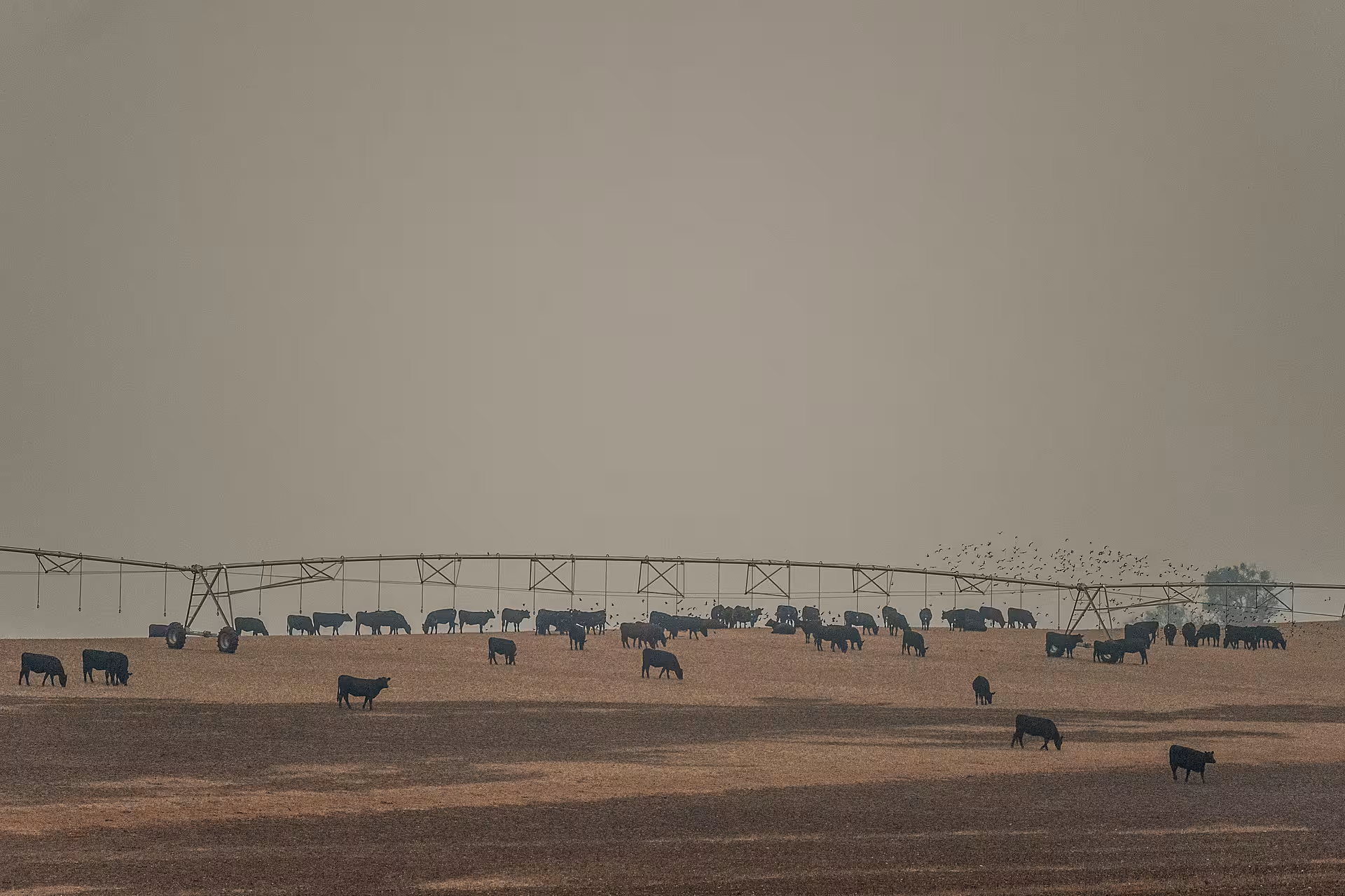


Factory farming is often regarded as a necessary evil and the only means of feeding a growing global population. While this is false on a number of fronts, one of the most glaring is that there won’t be a human population if we don’t seriously rethink and reorganise the way we produce food.
That’s because factory farming is simply not sustainable.
Right now, factory farming is destroying our environment. Not only is it a major emitter of greenhouse gasses and user of freshwater, but it’s also the largest driver of deforestation in the Amazon rainforest. Let’s take a look at how factory farming harms the environment, animals, and humans.
What is factory farming?
Factory farming is a type of industrial agriculture that focuses on raising animals. Virtually all animal products in grocery stores come from animals confined within one of these facilities.
Despite packaging that tries to convince you otherwise, factory farms are overcrowded places that often prevent animals from expressing many of their natural behaviours, instead prioritising producing as many products as possible in order to maximise profits.
How does factory farming affect the environment?
It’s not just the animals being farmed who are affected by factory farms. The facilities also have a damaging and often detrimental impact on the environment.
Land use and deforestation
Agriculture uses an astonishing amount of land – half of all the habitable surface of the world. Though much of that is used to grow crops, many of those crops go to feeding farm animals instead of people.
Including both land used to house farmed animals and cropland used to grow feed, 77% of all land is put toward animal agriculture.
Much of the land used to grow crops for cattle feed or house animals used to be forest. In fact, in the Brazilian Amazon, more than 800 million trees have been cut down to support beef production between 2017 and 2022.
The myth of climate-friendly chicken
In an effort to be more environmentally friendly, it may seem like a good choice to swap out beef for chicken. The reality, however, is that chicken is still bad for the environment, if not as bad as beef.
A chicken still needs to consume nine calories to produce a single one, making chicken calorically inefficient. When it comes to water usage, it takes 492 litres to produce just one 4 oz serving, meaning chicken has a large water footprint.
While chicken may not be as environmentally bad as beef, the reality is that the best way to eat in an environmentally conscious way is to remove meat and other animal products from our plates.
Greenhouse gas emissions
Animal agriculture is an often-overlooked emitter of greenhouse gasses. In fact, the sector produces more gas than the entire global transportation industry. Much of the gas emitted is methane, which is 20 times more damaging than carbon dioxide.
Air pollution
Farms are major air polluters. Their pollution doesn’t stay within the vicinity of the farm, either. Recent research conducted by a team of scientists at University College London found that farms are responsible for more than a fourth of all particulate pollution in cities across the UK.
In Leicester, 38% of particulate matter in the air in 2019 came from farms; in London, farms accounted for 25% of particulate matter polluting the air.
Water usage in agriculture
In agriculture, water is used to grow crops. Historically, most of those crops were used to feed humans. But since the rise of factory farming post World War II, that has changed.
A large percentage of crops grown today are fed to animals in intensive farming systems. Around 36% of the world’s crops support factory farming; 9% is used industrially, and just over 50% is consumed directly by humans.
By adding an extra step - needing to grow and feed crops to animals before eating the animals - a huge amount of energy is wasted. In fact, it takes 25 calories to produce just one calorie of beef.
Water footprints
A water footprint is the amount of water we use. It’s calculated by adding together the water needed to support your lifestyle, but also less obvious processes such as electricity usage, shopping, and recycling.
The food you eat represents roughly two-thirds of your water footprint. The types of food you choose to eat can dramatically increase or decrease that proportion. Though there are some plant-based foods, such as nuts, that require a large amount of water to produce, animal products tend to use the most.
Effects on local water quality
According to the British Parliament, only 14% of rivers in the UK were considered to have ‘good ecological status’ in 2022. While there are numerous sources of pollution including sewage, roads, and plastic, one of the most significant is agriculture.
Several cases in the UK, most famously on the River Wye, have seen industrial chicken farming wreck local habitats and environments. Industrial chicken farms create huge amounts of manure, which is then spread on fields as fertiliser. Then rainwater and erosion washes this manure into rivers, spiking the waters’ phosphate contents and killing wildlife with toxic algal blooms, turning rivers the colour of pea soup.
What are the effects of factory farming on animals?
Though factory farms harm all of us, animals are the primary victims. Dairy cows are repeatedly impregnated and calves are separated from their mothers shortly after birth. If the calf is a female they’ll endure the same fate of their mother. If they’re male they are raised as beef, veal, or simply killed shortly after birth.
Meanwhile, on farms that raise chickens for meat, birds are slaughtered at just a few weeks old. Many of the chickens don’t even make it that long due to their swift growth rate and the health problems – such as heart and bone conditions – that being bred so large causes.
At the end of the day, the fact is that factory farms are synonymous with suffering - regardless of the species being raised.
What are factory farming’s effects on human health?
Factory farms are a causal factor for a number of human health issues. Because meat is produced so cheaply and on such a large scale, it encourages people to overconsume, leading to heart and other health issues. The large amount of antibiotics used preventatively on factory farms also contributes heavily to antibiotic resistance.
Factory farms also provide the perfect place for zoonotic diseases to mutate and spread, making them the likely source of the world’s next pandemic.
Already diseases are spreading from animals to humans more frequently. With avian flu sweeping through flocks of birds around the world and mutating to infect everyone from seals to cats, it’s only a matter of time before a disease makes the jump to people and reaches Covid-19-esque levels.
When it comes to the staff working directly on factory farms, the health consequences are especially severe. The large amount of particulate matter and chemicals they’re exposed to can cause severe asthma and even death. It’s not just their physical health they need to be wary of either; chemical exposure and the trauma of working in a slaughterhouse can also lead to decreased mental health.
How do factory farms impact the health of those living nearby?
Factory farms jeopardise the health of neighbouring communities. For example, those nearby are placed at increased risk of contracting zoonotic diseases, as they are the closest to the animals and the workers who spend their days handling the animals directly.
The people living near factory farms also experience the greatest fallout from the facility’s pollution. Ammonia in the air can cause a myriad of diseases, including lung cancer and heart disease.
How can consumers help reduce the suffering of animals on factory farms?
The best way to combat the suffering of animals on factory farms is simply to remove them from your plate. If demand for animal proteins, dairy, and eggs drops, fewer animals will be raised for these purposes.
You can also support our ongoing campaigns to eliminate the worst suffering of animals raised for food.
What would happen if we only ate plants?
If everyone on earth stopped eating meat, the environmental impact would be profound. The move would cut greenhouse gas emissions by two-thirds. The amount of water used to produce our food – currently about one third of drinkable water – would drop exponentially, and large amounts of land could be reforested and rewilded.
Human health would also likely improve. Because red meat consumption is closely tied to the prominence of heart issues and processed meats are carcinogens, the incidence rate of several diseases would likely drop.
Despite the significant benefits of eliminating meat from our diets, there are still those detractors who claim that doing so would be impossible. That’s why it’s important for us to start the process of phasing animal agriculture out and eliminating the worst suffering of animals raised for agriculture.
How you can help
Whether this article is your first introduction to the environmental impacts of factory farming or you’ve been campaigning on the frontlines for years, there are actions you can take to help.
- Eat more plants and plant-based products, and less (or no) meat and dairy.
- Sign up for our newsletter to stay up-to-date on the work we’re doing, and how you can get involved.
More Like This

Why beef is bad for the environment, explained
It’s a fact that industrial cow farming has a huge impact on the environment. But what are the problems?


Factory Farming: What It Is and Why It's a Problem
A huge proportion of food is produced in factory farms around the world, but they are often hidden away.

SUPPORT OUR WORK FOR ANIMALS

About The Humane League UK
We are a charity ending the abuse of animals raised for food.
Learn More