


22 facts about turkeys that you might not know
These facts may just change the way you think about turkeys.


These facts may just change the way you think about turkeys.
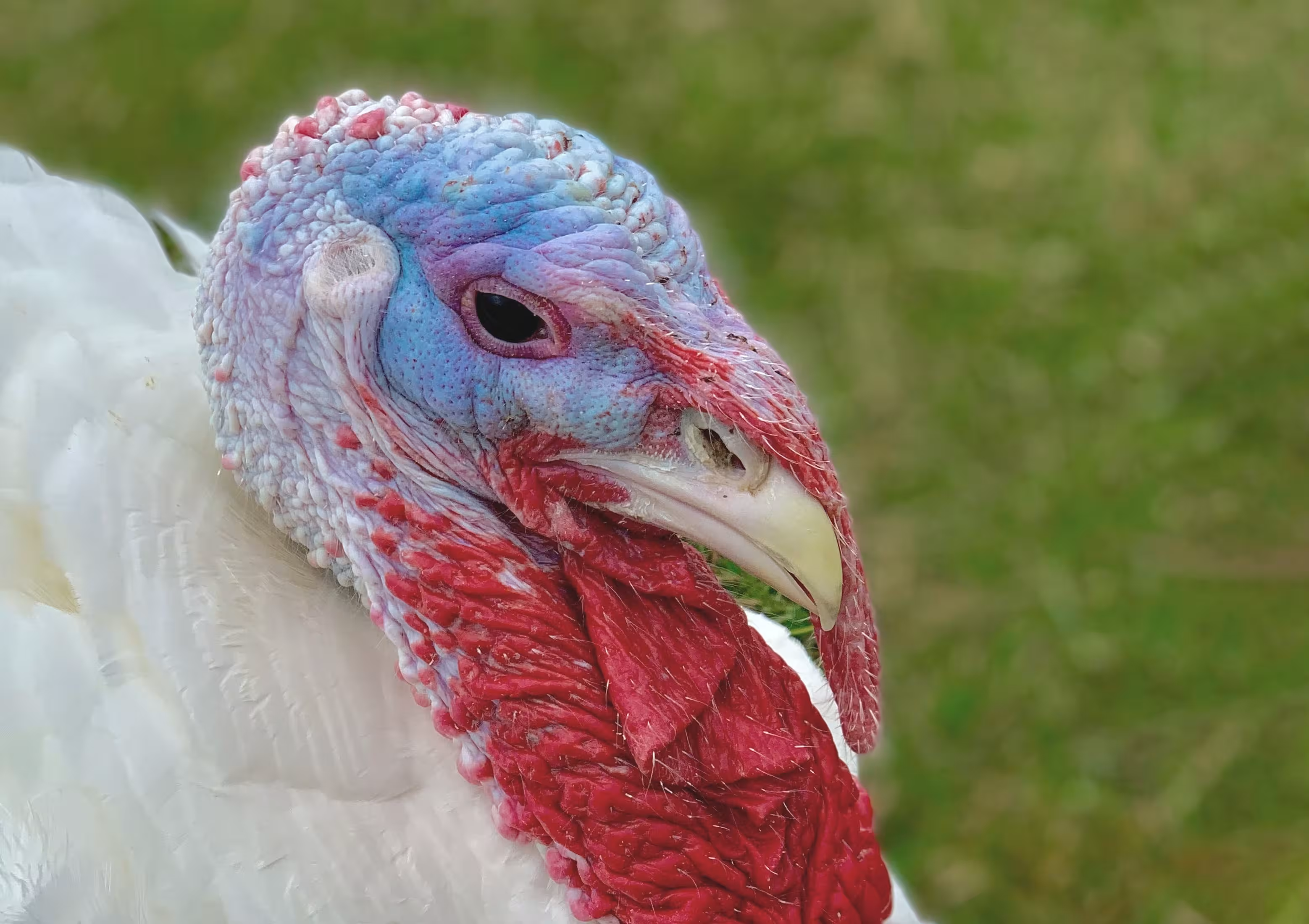


Many people only think about turkeys in December, when two million of them are slaughtered in the UK alone for Christmas dinner. But did you know that there are millions of turkeys who live in the wild, spread all across North America and Canada?
In their natural habitats, turkeys live very different lives compared to their exploited counterparts, who are sadly forced to suffer on factory farms. Turkeys are intelligent, sensitive, affectionate animals with tight social bonds. Here are 22 facts about turkeys you probably didn’t know.
1. Not all turkeys gobble
Although famous for their ‘gobble’, it is only male turkeys (toms) who actually make the noise. The function of gobbling is to establish territory and attract females.
Turkeys make a wide array of noises for greetings, warnings, mating calls, or singing for pleasure. These noises include cackling, yelping, chirping, clucking, whistling, and even purring like cats when content!
2. Females like an impressive snood
The distinctive appendage that dangles from the top of the turkey’s beak is called a snood. These are larger in males and convey a lot of information to other turkeys.
Females look to these to help choose a mate; they prefer males with longer snoods, as this indicates good health. Dominant males tend to have longer snoods, which can serve as a warning to other toms not to start trouble. The snood also tells a tom’s age.
Close up of turkey head and neck showing red snood

3. Turkeys can fly
While turkeys look a bit bulky, they can actually fly at speeds of up to 55 miles per hour. They can even swim, if necessary.
Only wild turkeys have the ability to fly. Farmed turkeys have been bred to grow so abnormally large (over twice the weight of wild turkeys) that they are not able to fly, and are also much slower on the ground.
4. Turkeys live up to 10 years - when given the chance
Naturally, turkeys can live for up to ten years. Unfortunately, turkeys raised for food are slaughtered very young, at around only five months old.
5. Turkeys sleep in trees
Wild turkeys usually like to sleep among their flock, up in trees. This is to keep safe from predators. Turkeys will also call out to each other to ensure everyone is safe when they need to come down.
On factory farms, turkeys don't have the opportunity to perch up high in trees at all.
6. Turkeys are great mums
Baby turkeys (called poults) are unable to fly at birth, so their mother stays with them on the ground for the first few weeks of life. Turkey mums will work to keep her poults safe until they are strong enough to roost up in the trees. On factory farms, young turkeys sadly don’t get the benefit of their mother’s care.
7. Turkeys can be sexed by looking at their poo!
Even if you can’t see or hear a turkey, it’s easy to determine their sex by simply looking at their poo! Males produce distinctive J shaped stools, while female poo is a spiral shape.
8. Turkeys have better vision than humans
Turkeys have excellent full-colour vision. With only a small turn of the head, turkeys actually have a visual field of a full 360 degrees, making them adept at spotting predators.
9. Turkeys eat a diverse diet
Like humans, turkeys like to eat together, with foraging being a communal activity. In the wild, turkeys are largely plant-based, foraging for grains, bulbs, leaves, and grass among other plant matter. But they will also eat insects, snails, and sometimes small reptiles like salamanders. When berries and other fruit that grows close to the ground are available, they’ll eat those too.
On factory farms, turkeys do not have the opportunity to forage for food, but are rather fed at feeding stations. Boredom and frustration on farms can push some turkeys to cannibalism.
Turkey in woodland
10. Benjamin Franklin preferred the turkey to the bald eagle
According to a private letter to his daughter, written in 1784, US President Benjamin Franklin stated he believed eagles have “bad moral character” because they steal food from fishing hawks instead of fishing for themselves.
By comparison, he felt turkeys were “a much more respectable bird” and “a bird of courage” who he believed would defend their territory against soldiers of the British Guard during America’s Revolutionary War.
11. Nearly 50 million turkeys are killed annually for Thanksgiving
Around 46 million turkeys are killed each year to become Thanksgiving dinner in the US. That’s a massive 21% of the 216.5 million turkeys slaughtered in the US each year. The Sentience Institute estimates that 99.8% of turkeys in the US live on factory farms.
12. Presidential pardons for turkeys started in 1989
The tradition of gifting turkeys to US presidents began in 1947, when the turkey industry sent President Harry S. Truman crates of turkeys to protest against the Government encouraging people to have “poultry-less Thursdays.” After that, turkeys received intermittent “pardons,” such as when First Ladies Patricia Nixon and, later, Rosalynn Carter sent the turkeys given to their husbands to animal sanctuaries. But the first official pardoning of a turkey didn’t occur until 1989.
While the pardoning tradition is certainly better for the one turkey each year, more than 200 million will not be shown such compassion as they are sent to slaughter.
13. An adult turkey has around 5,000-6,000 feathers
Turkeys have gorgeous, iridescent feathers that serve many purposes, such as making them attractive to other birds, and keeping them warm and dry. Adult wild turkeys can have between 5,000 and 6,000 feathers - though their tails are made up of only around 18 large feathers - with variations in colour and patterns between genders and breeds.
Turkeys raised for meat don’t get the chance to grow their full complement of feathers. At “maturity” (when deemed ready for slaughter) they’ll only have around 3,500 feathers.
14. Turkeys can run fast
Turkeys are pretty big birds, but that doesn’t stop them from being quick when they need to be, like when they are outrunning predators. On foot, a wild turkey can reach speeds of up to 25 miles per hour.
A farmed turkey who has been bred to grow larger than their wild cousins most likely wouldn’t have the opportunity to run during their confined life.
15. Farmed turkeys have more than doubled in size in the last 50 years
As with chickens, farmed turkeys have been getting larger and heavier over the past few decades.
Turkeys raised for meat in the US today have doubled in size in the past 50 years. But this isn’t a natural occurrence. It’s the result of selective breeding to meet demand, in particular for more breast meat. Their abnormal size also means it's harder for them to mate naturally, so most turkey breeding is done using artificial insemination.
16. Turkeys can change the colour of their heads
The head of a male turkey can change from red to white to blue depending on if he is excited or agitated. When his head goes white on top, this may be a type of signal to females that he’s on the lookout for a mate.
17. A turkey's wattle is not just for looks
The red flesh that dangles from a turkey’s chin is called a wattle. It has several uses, including helping turkeys to regulate their body temperature in the heat, since they can’t sweat. Like the snood, they also play a role in mating. During courtship, extra blood flows to the wattle, making it appear brighter red to appeal to females.
Wattles can also show when a turkey feels fear, as the appearance of a predator can make it turn blue as blood withdraws from it.
18. Turkey beards grow 3-5 inches per year
Male turkeys grow beards - but not from their chins and necks. Instead they grow from their chests, in plumes of dark brown or black feathers.
Turkey beards can grow at a rate of about three to five inches annually, and in some cases reach as long as 12 inches. Some toms can even grow multiple beards - usually just a couple, but for some as many as 13.
19. Male turkeys put on a show to impress females
Toms perform courtship displays involving various body movements and vocalisations to attract females, guard their territory, and compete with other toms. They will puff out their body feathers, fan out their tails, strut, and gobble. They will also beat their wings against their bodies to make a drumming sound.
20. Turkeys have friends
Outside of breeding season, toms will form a group with other toms, while females raise the chicks. Sometimes, multiple family groups of mothers and children will form a larger flock. Females have stable hierarchies, but males will eventually fight to establish dominance.
21. Turkeys have sharp talons and beaks
Wild turkeys have sharp beaks and talons. When two males fight, they will use their beaks to gouge eyes and tear skin. They may also lock their beaks together as they battle for dominance.
But their beaks serve other purposes too, such as helping them find food as they peck and pluck, or cut things they want to eat. They also use them for grooming and spreading oil over their feathers.
On their feet, turkeys have talons that they use to scratch and dig in search of food, aiding them in times of scarcity. In addition, the males have spurs, or long claws on the back of their legs, which serve as an excellent weapon for defending themselves.
Most turkeys raised for meat don’t get to perform these natural behaviours, as they often have their beaks and talons trimmed to stop them from injuring each other in such cramped conditions.
22. You can help turkeys
Turkeys are amazing animals who deserve much more than to suffer on factory farms. The most impactful change you can make as an individual is to leave them off your plate.
Your voice is so valuable in creating change for animals. If you share our vision of a world free from animal abuse, you can sign up for our emails. You'll receive regular updates and ways to take action for animals raised for food.

More Like This

What is poultry farming and why is it bad for animals?
Poultry farming is mostly hidden from sight in the UK. So what does it involve, and what does it mean for animals?


What’s life like for a factory-farmed turkey?
We explore the key welfare issues for farmed turkeys and offer some tasty plant-based alternatives.

SUPPORT OUR WORK FOR ANIMALS

About The Humane League UK
We are a charity ending the abuse of animals raised for food.
Learn More