Is speciesism a real word?
Speciesism is a real word. It is listed in Merriam-Webster Dictionary, Cambridge Dictionary, Britannica, and Dictionary.com.
What is speciesism?
Speciesism is the belief that certain species of animals are superior to others, and that this unequal status justifies mistreating members of inferior species. This particularly applies to the widespread view that humanity is superior to other animals, and can therefore treat other animals however we like.
Merriam-Webster has a clear definition of speciesism -
-
prejudice or discrimination based on species, especially discrimination against animals
-
the assumption of human superiority on which speciesism is based.
Who coined the term speciesism?
The term was coined in 1970 by influential writer, psychologist and animal advocate Richard D. Ryder, former president of the RSPCA.
While Ryder coined the term, it was utilitarian philosopher Peter Singer who popularised it. Peter Singer condemns speciesism as a “prejudice or attitude of bias in favour of the interests of members of one’s own species and against those of members of other species.”
What is an example of speciesism?
Speciesism appears in society in numerous ways.
There is an outdated belief that human beings are the pinnacle of evolution - that we sit on the top of the Darwinian ladder, with all the other species placed on rungs beneath us, from other mammals, down to birds, then reptiles, amphibians, fish and then invertebrates. On this view we are the climax of evolution.
However this view misrepresents reality. It is more accurate to envision all species living today as branches spreading from a tree, with no single species placed above the other. No animal is “more evolved” than another, only more specialised for different tasks and niches. All animals and plants are equally as evolved - each has been evolving in different directions for 3.8 billion years. While non-human animals may lack certain human qualities - abstract thought, complex technology and so on - they may also exceed us in many ways i.e. run faster, see better, be stronger.
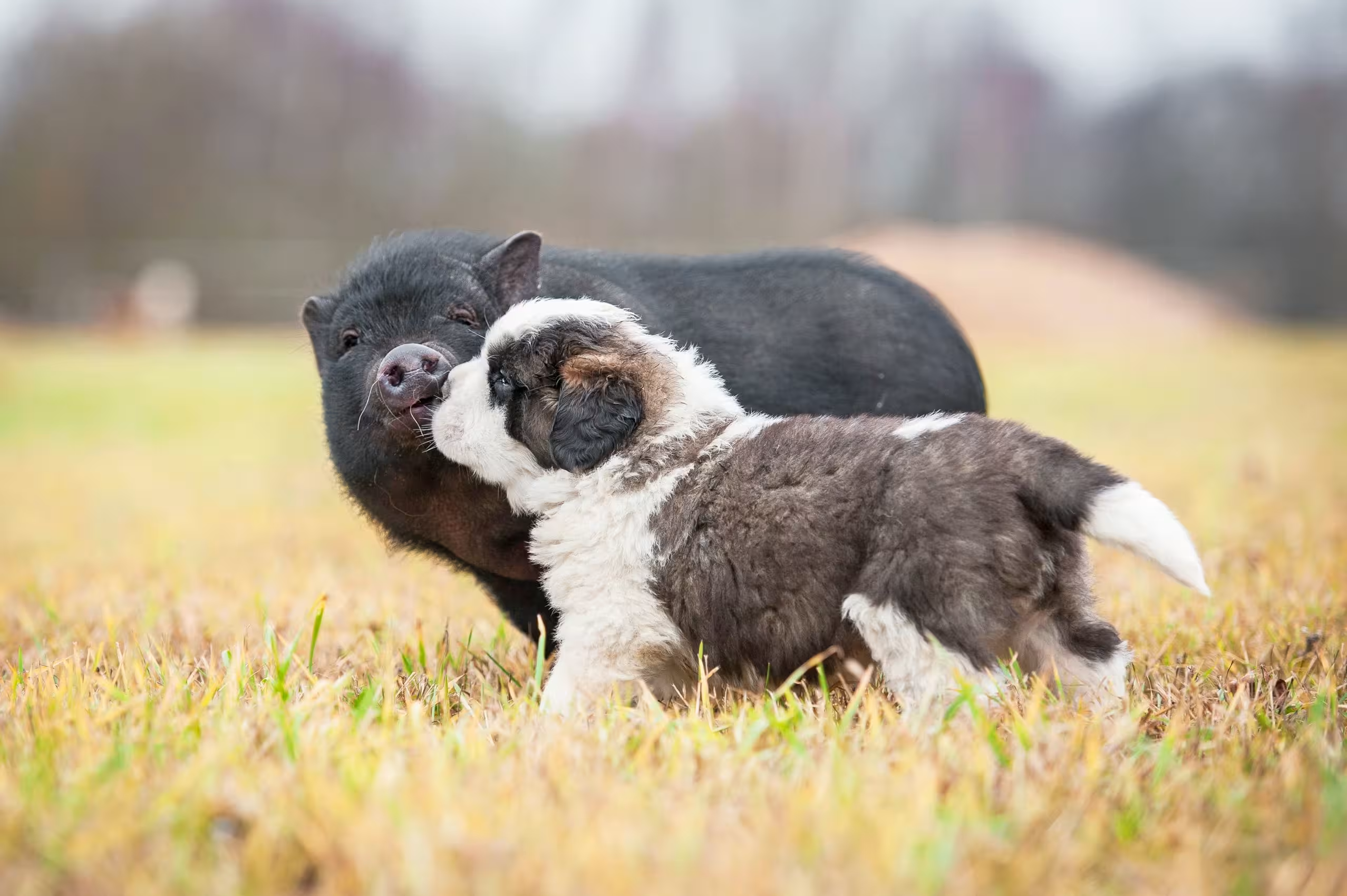
The unjustified nature of speciesism is clear when we consider how humans view different species - dogs and pigs are a good example. Pigs and dogs are both mammals of comparable intelligence. They both experience joy as well as fear, pain and a range of other emotions. Yet because of historical reasons (the usefulness of dogs in hunting and herding) and a subjective preference for the appearance of dogs, we cherish and protect dogs in the UK while mutilating pigs and killing them for human consumption.
The fact that speciesism is arbitrary and culturally conditioned is further highlighted by the fact that humans don’t universally treat certain species in the same ways across the world. In countries like South Korea or Nigeria dogs are still killed for food and in Islamic and Jewish communities, pigs are considered unclean, and forbidden to eat. Among Hindus cows are held as sacred, and slaughtering them is considered a crime, but in the UK, roast beef is popular. Chicken meat is now the UK’s favourite; but when the Romans first encountered Britons two thousand years ago Britons held chickens as sacred, and refused to slaughter them.
Human beings raise and kill tens of billions of animals for food every year, mostly in factory farms. Because many people believe animals are lesser and sufficiently different to us, they believe that this treatment is justified. However, many philosophers have argued otherwise and their objections often rest on one major similarity - the fact that animals can feel pain.
Why is speciesism wrong?
In a 1789 paper, renowned English philosopher Jeremy Bentham argued that humans have an obligation to treat animals with respect because animals are sentient beings with the capacity to suffer. He said:
“
“The question is not, Can they reason?, nor Can they talk? but, Can they suffer?”
Because animals suffer, they should be entitled to treatment which respects their sentience, and should be afforded certain rights. Speciesism is wrong because it is logically inconsistent - human suffering is considered extremely important among speciesists, but animal suffering is considered trivial at best, or irrelevant at worst.
Arguments in favour of speciesism vs. against speciesism
People will often argue that human suffering matters, when animal suffering doesn’t, because humans possess certain qualities that animals don’t. Common examples include possessing higher intelligence, a higher capacity for pain or that eating animals is ‘natural’.
Justifying harming animals because humans are more intelligent is unconvincing because there is a spectrum of intelligence within humanity. However, people rarely argue that the more intelligent members of society should be able to physically harm and kill the less intelligent members.
When it comes to pain there is no way to measure if a human or a cow feels more pain. Certainly, animals do feel pain - when exposed to noxious stimuli their blood pressure will go up, they will scream or vocalise their displeasure, they may urinate or defecate, and they will avoid the cause of distress in future. There are even some reasons to think that animals may feel more pain than humans. While humans can disassociate from painful experiences, or have their stress reduced in a given situation by receiving verbal reassurance, animals have to rely on their sensory organs much more than their brain, and are seen to live in the present moment. As such there may have fewer ways of avoiding the experience of pain and fear.
There is also the argument that it is ‘natural’ to harm animals for food, implying that it is therefore ‘good’ or at least neutral to do so. There are many things that occur in the natural world which we would consider morally bad - cannibalism, rape, infanticide etc. There are also many things people rely on in society that are not ‘natural’ - medicines, central heating, cars, showers, aeroplanes. These things aren’t considered evil because they are unnatural. Given that a well planned plant-based diet is healthy at all stages of life, rejecting speciesism does not compromise health, and there’s no reason to consider anti-speciesism as being more ‘unnatural’ than any other human idea.
Speciesism movies
Speciesism has been explored in many popular films.
- Speciesism: The Movie(Documentary). Entertaining documentary following a filmmaker who sets out to investigate factory farms and ends up exploring the broader topic of speciesism itself.
- Babe(Feature Film). After learning that humans kill and eat animals who aren't "useful" alive, an orphaned piglet sets out to prove he's as good at herding sheep as the resident border collies who've become his foster family.
- The Fox and The Hound (Animated Film). An orphaned fox cub is raised alongside a puppy and become best friends. But when they grow up, the humans who have cared for them expect the dog to become a hunter and the fox to become the hunted.
- Rise of the Planet of the Apes (Feature Film). After serving as a laboratory test subject, a chimpanzee recognizes how humans exploit his kind and other apes in laboratories, zoos, and rundown roadside attractions. He frees other apes and leads them in a fight against human tyranny.
- Chicken Run (Animated Film). When they learn they're going to be killed and turned into filling for chicken pot pies, a group of chickens enlist a cocky rooster to help them hatch an escape plan.
- Sweet Tooth (TV Series). A boy who's half-human and half-deer is forced to survive human hunters as he searches a post-apocalyptic world for his mother.
- Earthlings (Documentary). Powerful documentary chronicling the ways in which human civilization exploits and abuses various animal species deemed food, clothing, entertainment, test subjects, and even pets.
What can I do about speciesism?
To help create meaningful changes for animals raised for food, Sign this petition to tell the UK Governments that they must ban cages for all laying hens by 2026.
Sign this petition by Chris Packham, which calls on the Government not to abandon its plans to ban fur and foie gras.
You could also sign this petition which calls on the UK government to give fish the same protection as other farmed animals.
Finally, sign up to take part in our campaigns and make a real impact for animals farmed for food.


 Matthew Chalmers