


Jonathan Balcombe on why he wrote a kids book about fishes
Jonathan tells us about his new children’s book, his own experience of fishing as a boy, and the challenges of getting people engaged on fish welfare.


Jonathan tells us about his new children’s book, his own experience of fishing as a boy, and the challenges of getting people engaged on fish welfare.


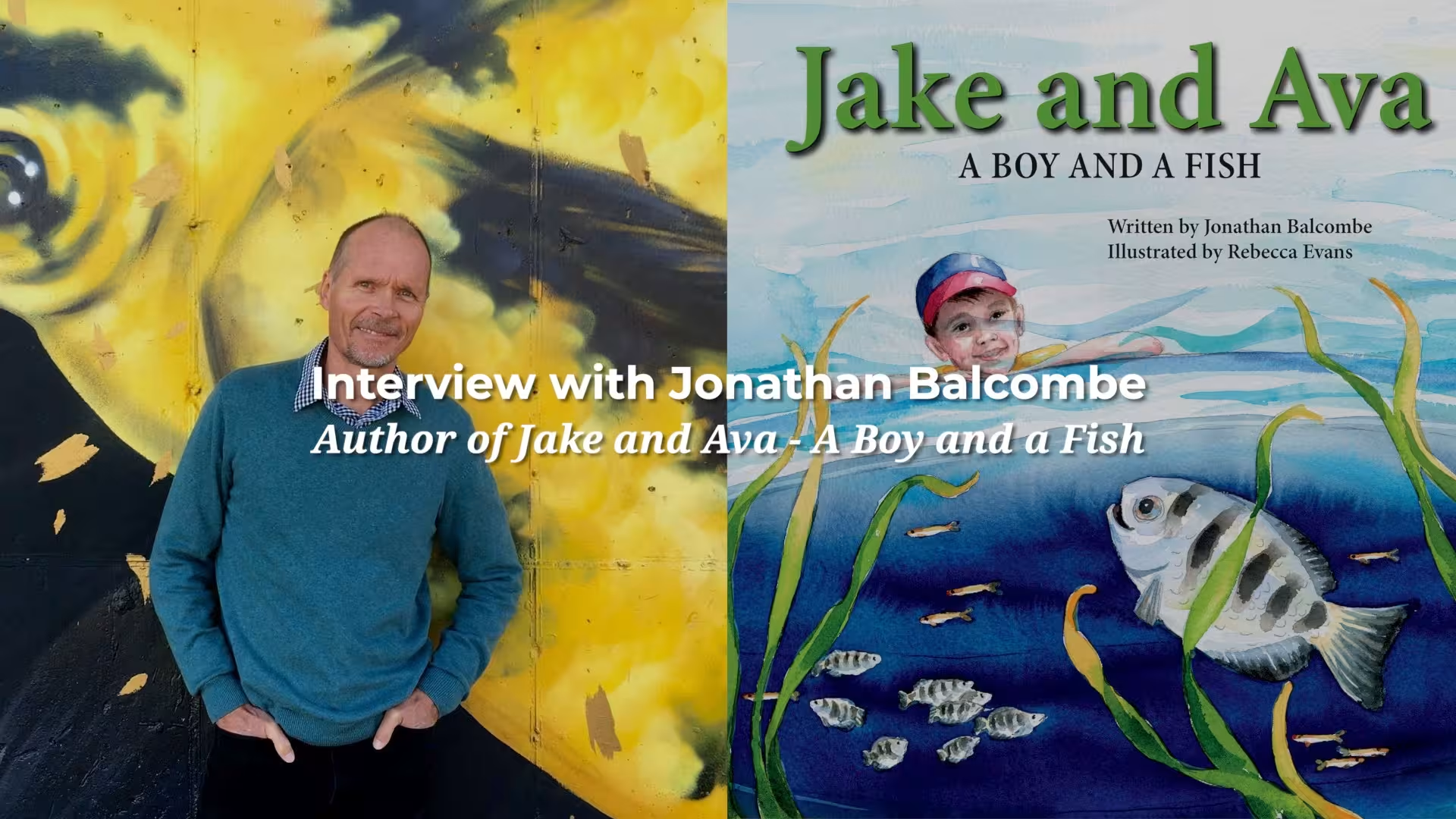
Scientist and author Jonathan Balcombe is well-known for his books on the amazing worlds of fishes and flies. His new book ‘Jake and Ava - A Boy and a Fish’ is his first aimed at children. We find out what it’s all about.
Full video transcript
What is Jake and Ava about?
“Jake and Ava, A Boy and a Fish" tells two parallel stories of a boy going fishing for the first time and a fish going insect catching for the first time. And they proceed on a parallel and then the boy catches this fish and their two stories converge. And it becomes a story of empathy from that moment.
What inspired you to write a children’s book?
Well I think of children as a very important audience to reach if one can. I mean the future leaders are the young people of today.
I've always thought it would be fun to write for that audience, to have the freedom of writing fiction rather than nonfiction, although I love to write nonfiction.
And I had an experience as a child fishing and I think it probably reflects the experience of many children who have misgivings about the activity but don't express them and suppress them because the grownups, the ones we look up to, the leaders of today you know are saying it's good it's okay you know. So I wanted to try and validate those feelings of concern that I think a lot of children have as I did.
Is the book based on your own experiences?
The story of "Jake and Ava, A Boy and a Fish" is set in a very different place with different kinds of fish than I experienced as a child growing up in Ontario, Canada at summer camp when I was taken out fishing.
But the emotional experience, the physical and emotional experience, is quite similar with the father figure, in this case Jake's granddad. This beneficent nice avuncular man and this young boy who's all excited about the experience.
And the experience turns into unexpected emotions that arise when he actually catches the fish and sees the fish. And he's a boy like I was with quite a large capacity for empathy to put oneself in the place of the other. And he immediately identifies with the fish when the fish comes out and he sees this fish with the hook in the mouth, hanging, gasping to breathe.
And it doesn't take much imagination to conclude that that fish is not a happy animal, the fish is suffering and there's a risk of dying. And I've never fully grasped why some people seem to be just completely shut off to this and don't seem to be bothered by that or disturbed.
But I do know there are many who identify with the fish and feel sorry for it. And my impulse was I just wanted those fish to go back in the water when I saw them pulled out.
Why did you choose an archerfish in this story?
I was motivated by the remarkable behavior of these fishes. Archerfish are named… there's six known species and they're named for their ability to aim and shoot water at flying insects or perched insects.
But flying insects particularly requires a lot of skill. And they actually have been shown in captive experiments to be able to learn that skill or hone it without actually doing it themselves by watching other archerfish who are experienced. And just by watching that they can become more proficient without doing it themselves. That's called learning by observation which is considered a quite high level cognitive feat.
So the fact that they show this awareness, it's not built into their system, they need to learn it, there's a learning curve. Just like a surgeon learning to do heart surgery say, you know archerfish have to learn and they have to hone their skills to become good at it. So all of those kinds of characteristics I thought lent themselves well to impressing upon the reader that fishes do neat stuff.
My book "What a Fish Knows" for grownups is all about that and connecting that to our troubled relationship with these animals. So that was the idea there was to take a species with really interesting behavior and hopefully raise eyebrows and make people think and scratch their heads a little bit more than we usually do about these animals which are so commonly demeaned as unfeeling and unthinking which science has shown is radically not the case.
Do you have any tips for parents or guardians on how to get their children interested in animal welfare?
I think so much of what children learn and take on board is through the example set by the grownups which is why taking them fishing is such a potent message. Not necessarily for the good. I would say not for the good.
You know we take our cues from the grownups when we're kids. All grownups today were kids at one time. And we look to the grownups consciously or subconsciously as sort of the guides of how we should behave. Often we don't do a good job at behaving in ways that we want our kids to learn. Don't do it as I did it kind of thing.
So I would say for parents who you know were raising children, I've raised a daughter. I think taking them out in nature and teaching by doing. You know just the act of seeing a caterpillar and stooping down to look closer or rescue it from a footpath where it might get squashed and to give voice to that and put it in the side where it's safe. Just catching a fly in a window and taking it outside and letting it go.
Powerful lessons there, just as the opposite kind of thing: squashing an insect or using a flyswat or insecticide spray, those send powerful messages that this is okay, this is the proper way to react. And I've seen kids squash insects and I know where they learned it. They learned it from someone bigger modeling the behavior for them.
What do you think some of the biggest issues will be for fish welfare with the encroachment of increased aquaculture?
Yeah it's an important question. I mean fish farming and aquaculture or factory farming of fishes has been the fastest growing sector of food production for human consumption in the last couple of decades at least.
You know aquaculture is a lovely word it sounds great but the reality of course is I like to call it factory farming of fishes 'cause that's really what it is - it's intensive confinement.
The animals have no freedoms they're stressed, they're crowded, there's competition, there's pesticides, there's pests or parasites. You know just problem after problem and mortality rates can be very high, stress rates are very high.
And also you know there's this sort of tacit belief that at least it takes stress and pressure off of wild fish populations which is not the case because most of the fish that humans like to eat are predatory fish. They eat other fish and the other fish typically that are fed to them in these aquacultural operations are wild caught menhadens, sardines and smaller fish like that.
So it doesn't really take pressure off wild populations. But even if it did, factory farming of fish has a host of its own problems both welfare and ecological environmental.
What are some of the biggest challenges in getting people engaged on fish welfare?
Yeah that was a big part of the motivation for researching and writing the book on "What a Fish Knows." A book that sort of brings - synthesizes - the current knowledge that we have of fishes and puts it in one place.
I'd love to say that just the knowledge, the facts is enough to change behavior. You know, get the information up here and people will get on board and they'll change. just show them what the fish do.
I think that has utility but unless you reach here, unless you engage emotions, you're only gonna get so far. Which is why as a science writer I've learned that telling stories is a very powerful and important part of delivering a message and changing behavior.
If you can tell a story that people relate to the fish they see not just a thing or a biological entity but an individual who has interests, concerns, thinks about things, behaves in a flexible manner, has emotions, can feel stress, shows parenting behavior, shows social behavior, virtue. I mean the list goes on of the things that fishes can and do do and that have been shown by science.
So I've learned as a science writer to include a lot of stories. Personal accounts if I have them but also stories from other people. So I think engaging the emotions by all means share facts. But the more we can engage people's emotions the better.
It is of course challenging, fishes evolved in an aquatic environment. They don't blink, they don't need to, their eyes are bathed in water. They do make all sorts of sounds but those sounds are propagated underwater and we don't generally hear them. So we're more restricted in how we can relate to them. We don't recognize facial expressions and body postures. The fishes tune into a lot of this stuff. It's subtle in nuanced ways but we don't.
So it is definitely challenging, I make no bones of the fact that the fishes are more challenging than any other vertebrate animal to get people to relate to. But we can do it and I think showing what they're capable of and telling stories is a big part of hopefully changing that view.
Help forgotten fishes
We're campaigning for important legal protections for farmed fish welfare in the UK. Take action to help fishes by signing our petition using the button below.
More Like This

Interview with Jonathan Balcombe
We ask fish expert Jonathan Balcombe all about fishes, flies and his favourite facts

The life of a farmed fish and their welfare issues.
Ever wondered what life would be like if you were a fish? Sadly, idyllic expanses of ocean are far from reality for farmed fishes.

SUPPORT OUR WORK FOR ANIMALS

About The Humane League UK
We are a charity ending the abuse of animals raised for food.
Learn More